
Where to start after a hailstorm
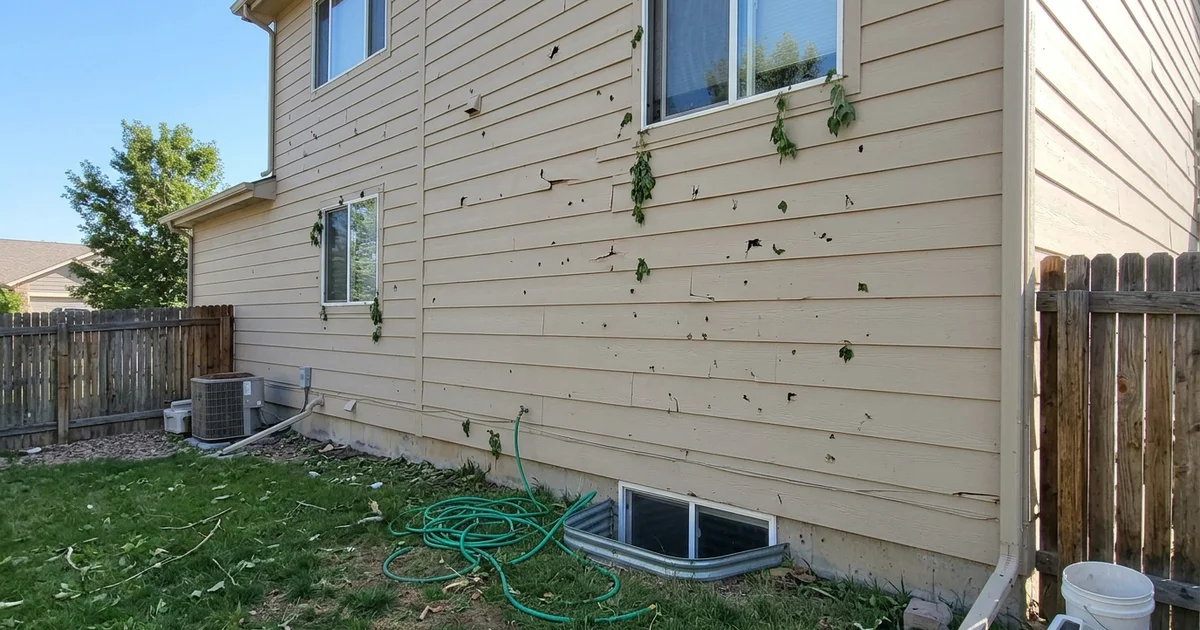
To spot hail damage on siding, start with the wall that faced the storm, then walk the whole house. Wind can push hail around corners, so the side walls can take hits too.
Don’t skip the check because the hail looked small. The National Weather Service calls 1-inch hail (about the size of a quarter) severe, but stones as small as 3/4 inch (a penny) can damage vinyl siding and window screens. So check siding after any hailstorm that rattled the windows.
Wait until the storm has passed and the ground is safe to walk. Look in good light, and look again in the morning or late afternoon, when low sun makes dents and dimples easier to see. A garden hose helps too. Water on the surface catches the light and shows dents you’d miss when it’s dry. If you’d rather have someone else look, our hail damage siding repair page explains how we go wall by wall.
Start with the clues around the siding
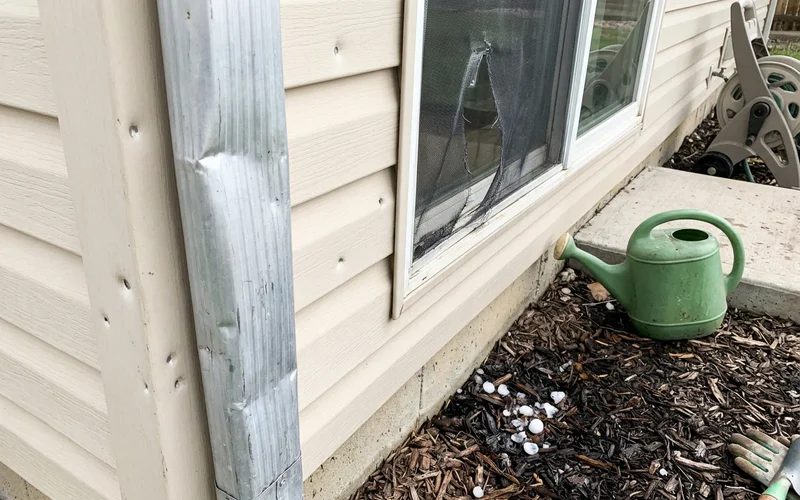
Check the softer, thinner things around the house first. They show hail faster and more clearly than the siding does. Look at these on each side of the house:
- Window screens. Small tears, dents or a stretched spot in the mesh.
- Downspouts and gutters. Round dimples in the aluminum, often in rows.
- Painted trim. Fresh chips or light marks where the paint was knocked off.
- Outdoor items. Dents on a grill lid, a mailbox, or patio furniture on that side of the house.
If the screens and downspouts on one side are dented and the other sides look clean, you know which walls took the most hail. That’s where to look closest at the siding.
What hail damage looks like on each kind of siding
Each siding material shows hail differently. Knowing what to look for on yours saves time and helps you describe what you see.
Vinyl siding: cracks and holes
Vinyl gets stiff in the cold, so hail tends to crack it or punch small holes instead of denting it. Hail holes in vinyl siding are usually easiest to find on the windward wall. Look for:
- Small round or star-shaped holes, often on the face of the panel
- Short cracks that start at a hole or at the bottom edge of a panel
- Pieces broken off at the bottom lip, where one panel locks into the next
Cracks can be hard to see from a distance. Stand close and look along the wall at an angle.
Metal and aluminum siding: dents
Metal siding dents instead of cracking. Hail dents in aluminum siding are round and shallow, and they can be easy to miss straight on. Look along the wall with the light coming from the side, and the dents show up as small shadows.
On older painted aluminum, hail can also chip the paint and leave bare spots. Those spots can start to oxidize, so note them even if the dent is faint.
Fiber cement siding: chips
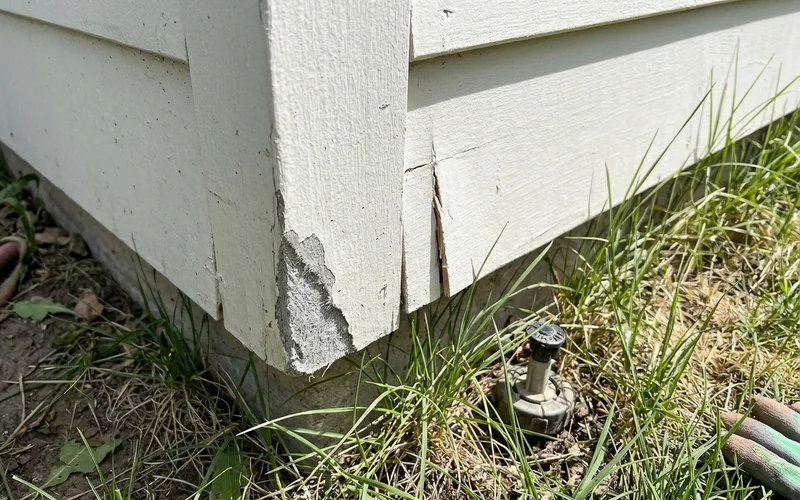
Fiber cement is hard and heavy, so it usually chips instead of denting. Look for:
- Chips at the corners and bottom edges of boards
- Small marks on the face where the paint and surface are broken
- Spots where the gray core of the board shows through
Wood siding: splits and dings
Wood can split along the grain when a hailstone hits it hard, especially near the ends of a board. Look for:
- New cracks running with the grain
- Small round dents in softer boards
- Paint knocked off in spots, leaving bare wood
Quick comparison
| Siding | What hail usually does | Where to look |
|---|---|---|
| Vinyl | Cracks and holes | Panel faces and the bottom lip of each panel |
| Metal and aluminum | Dents and paint chips | Along the wall in low, side light |
| Fiber cement | Chips | Board corners, bottom edges and faces |
| Wood | Splits and dings | Board ends and along the grain |
Why small hail damage still matters
Even a small crack or hole can turn into a bigger repair. It doesn’t look like much from the yard, but water finds it. Fort Collins freezes at night and thaws by afternoon for a good part of the year, and that cycle works on every opening.
Here’s how a small problem grows:
- Water gets behind a cracked board or into an open seam.
- It freezes overnight and pushes the crack wider.
- The next thaw lets in more water, which can reach the wrap and sheathing behind the siding.
A hole that reaches the wrap and sheathing can turn a small repair into a bigger one. Catching it early keeps the fix small.
How to note what you find
Keep a simple record as you walk the house. It makes every later step easier.
- Write down which side of the house each problem is on.
- Take photos of cracks, holes, dents and chips up close.
- Take a wider photo of each wall too, so it’s clear where the damage is.
- Hold a tape measure or a coin next to the damage in a few photos for scale.
- Photograph the screens, downspouts and trim on the same side.
These notes make it much easier to describe the damage on an estimate request. They also give you a clear record for yourself.
Date your photos, too, so it’s clear which storm the damage came from. Whether any of it is covered is up to your policy and insurance company.
When the damage is limited to a few pieces
If hail damage is spread over just a few panels or boards, we can take out the damaged pieces and replace them with matching ones, the same way any siding repair is done. When it runs across whole walls, the fix is bigger.
Either way, the first step is a close look at every wall, and your photos and notes help that go faster. Once you’ve walked the house, send what you found to Fort Collins Siding Contractors and request an estimate. We’ll confirm the damage and tell you what it takes to fix it.